1832 Mysterious Death of Elizabeth Threlfall - a murder on the Leeds Liverpool Canal?
From an article published by LancsLive in 2022 and Preston Chronicle 10th May 1851 and Reynolds Newspaper of 31st August 1851. It was a big story and appeared in almost every newspaper in the land in 1851.
Elizabeth Trelfall, born Elizabeth Orritt LZP8-DMM was found dead in the Leeds and Liverpool Canal near to Halsall Hill Bridge on October 16, 1832. Nearly two centuries later, mystery still surrounds the tragic drowning. The 26-year-old, Elizabeth had two children Henry Threlfall G2RP-SXR and John Threlfall G2RP-Q3P She had separated from her husband Thomas Thelfall MMYQ-645 who she had married on 8th November 1824.
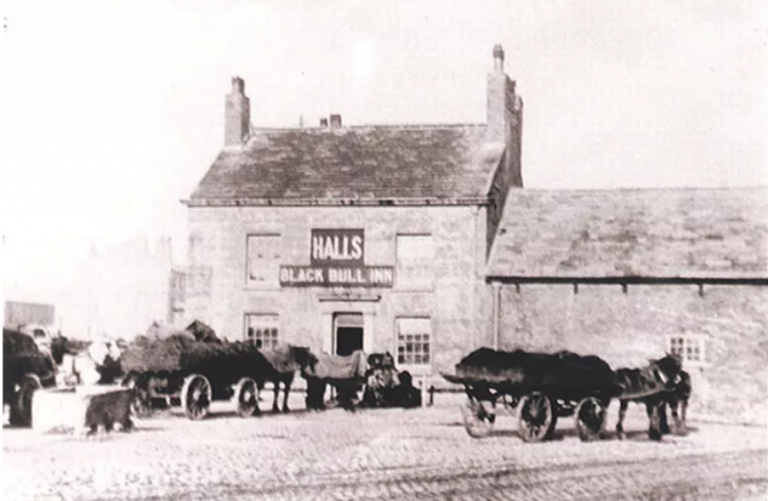
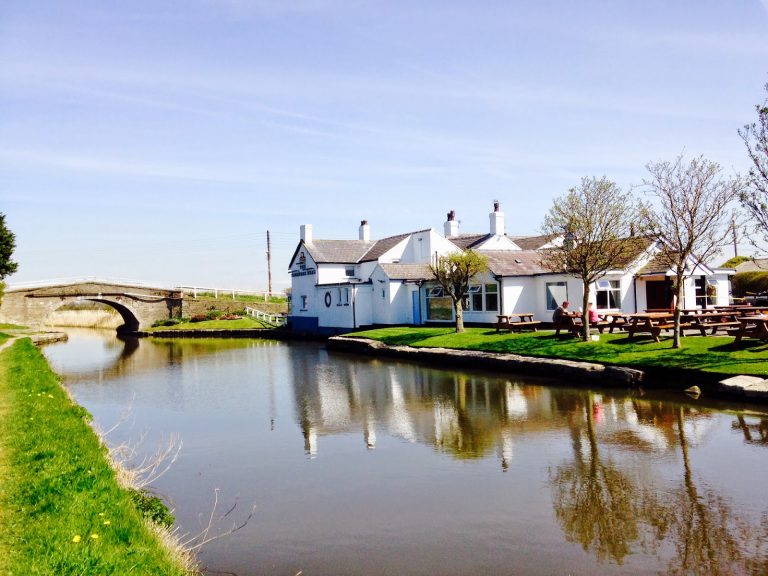
Black Bull Pub in Aintree
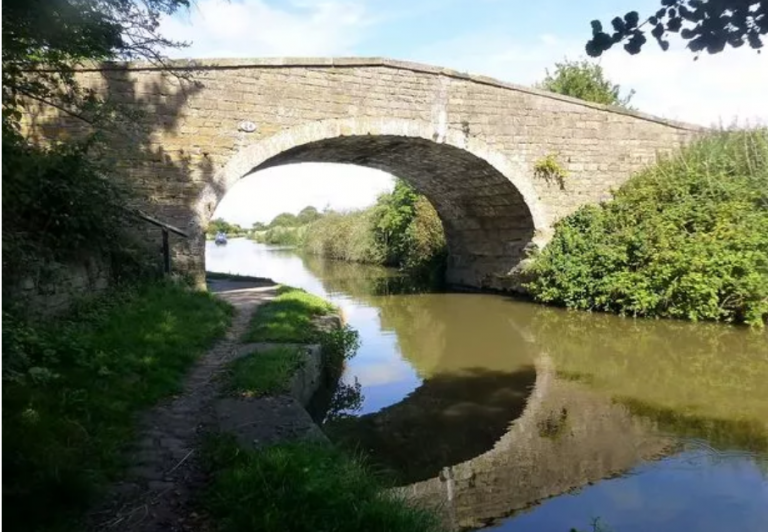
Elizabeth had taken up a job as a live-in servant at the Black Bull pub in Aintree some months previously. But the young mother was found by a couple of potato pickers, floating in the Leeds Liverpool Canal, near to a boat. They grabbed a pole and managed to pull the body to the canal side. The boat captain’s brother, Richard Shaw, helped lift the lifeless Elizabeth from the water and carried her to a nearby house, before taking her to Halsall Warehouse. The local police constable was called, and the coroner alerted. It was suggested that this was the wife of Thomas Threlfall, who in turn, was duly sent for.
Saracen's Head Bridge previously known as Warehouse Bridge
Mr Threlfall, on his arrival, confirmed that the dead woman was indeed his wife, the coroner gave his report to the local magistrates. The inquest would have been held in the Warehouse Bridge Inn, now called the Saracen’s Head.
Elizabeth was buried in St Cuthberts, Halsall Parish Church graveyard on 18th October 1832 .
Thomas Threlfall married Martha Jones MN3X-CCF on 25th May 1840 at St Peter’s Church in Liverpool. In the 1841 Census they were reported as living at May Place, New Goose Street, West Derby, Liverpool. The family consisted of Thomas and Martha, his two sons Henry and John and a new baby girl Sarah Threlfall G2RG-54R . Thomas was a Police Officer in Liverpool.
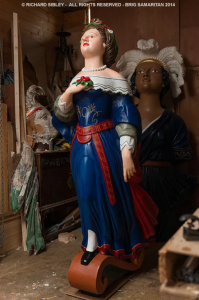
Replacement Figurehead of the Samaritan, Henry Threlfall's ship.
By 1851 the Threlfall family have moved to Old Wood, Preston Gubballs, Atcham, Shropshire. Henry and John had left the family home so the Shropshire family was Thomas, Martha, their daughter Sarah and two further children; Thomas Threlfall G2RP-3LD age 5 and Mary Threlfall G2RG-VWY age 2.
Thomas was now a farmer and an innkeeper as there was a new law, 1830 Beerhouses Act, which made it easy and profitable to open an inn in any building.
Henry Threlfall G2RP-SXR, the eldest son, became a Merchant Seaman, and he chose the wrong ship. He joined in 1842 and in 1846 the Samaritan was wrecked off the coast of Cornwall, on a voyage to Constantinople. There is an interesting article about how the local villagers were imprisoned for plundering the wreck, the ship’s figurehead was washed ashore and became a local monument so much so that the owners had a replacement carved in 2014.
Henry was one of only two survivors.
Things changed dramatically back in Halsall after 19 years when claims surfaced that Elizabeth had been murdered. The claims came from boatman Richard Shaw, whose brother had owned the boat near to where Elizabeth’s body was found. Richard made a death bed confession in 1851, claiming he had witnessed the young woman’s murder. He said he could not die in peace until he told the truth about what had happened on that night, almost 20 years earlier. Police were alerted, and inquiries soon unearthed that Mr Thomas Threlfall, Elizabeth’s husband, had now moved to near Shrewsbury. He was brought back to Ormskirk to face the court in April 1851, 19 years after his young wife had died.
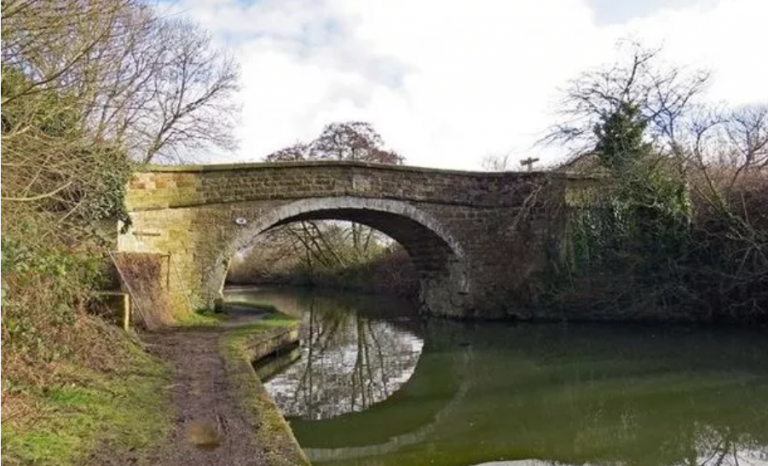
Halsall Hill Bridge where Elizabeth's body was found
The court heard how on October 15, 1832, Richard Shaw swore that he heard ‘scuffling’ as he lay in his brother’s boat’s cabin. Alarmed, he got up – and said he watched as Mr Threlfall threw his wife into the canal. The court remanded Threlfall to Kirkdale prison on a charge of murder, and he faced trial on August 27, 1851. The first witness, a farmer called Thomas Ball GCMS-7CS, testified to some grisly details, revealing how he had been one of the potato pickers who had discovered her body in the canal, with a handkerchief tied around her neck and pulled her out of the water and took her to a house. The second witness, a farmer called Thomas Kirby, said he had been the one to fetch the coroner and Mr Threlfall to alert them of the tragedy. He said Mr Threlfall didn’t want to come with him at first, and didn’t ‘seem troubled’ by the event.
Similarly, farmer James Kirby swore that when he went to get Thomas Threlfall to ask him to identify the person thought to be his wife , curiously, Mr Threlfall was initially reluctant to go until made to by the police constable. Mr Kirby also said that Threlfall didn’t seem ‘much troubled’ at this stage, and that there was no change in his behaviour. Another witness was Mary Hall, the daughter of the landlord of the Black Bull, where Elizabeth had worked, who testified to having seen Mr Threlfall twice at the pub while the couple were separated, and also to Elizabeth’s comings and goings in the weeks leading up to her death.
A statement from the main witness, Richard Shaw, read to the hearing, said: “About 18 years ago, I was sleeping in my brother’s boat between 12 and 1am, I heard a great bustle on the bank, a woman shrieked, the woman screamed for help and then I heard a plunge into the canal. I got up, looked through the porthole and saw Thomas Threlfall ducking a woman in the canal. The woman scratched at the stern of the boat.”
Lydiate Hill Bridge where the couple Thomas and Elizabeth last met.
A labourer called Robert Rimmer described witnessing some terse discussions between Thomas Threlfall and his wife, which ended with her agreeing to go back to live with him on condition that he take a cottage and they live by themselves. Mr Threlfall apparently promised his estranged wife: “I will be as good to you as I ever have been.” Yet Mr Rimmer told the hearing how he heard Threlfall asking Elizabeth to meet him the next day, but she could not, so they agreed to meet the day after, when she had done some washing by Lydiate Hill. But tragically, the young woman was found dead the day after.
Mr Shaw told the court how he saw a boat worker, John Beckett, approach Mr Threlfall after he’d thrown his wife in the canal, telling him he had to ‘run or be taken,’ and Mr Threlfall, he said, chose to run. Yet former boat worker John Beckett who also gave evidence, said he could not recall hearing of a woman being drowned and said Richard Shaw, the main witness, had never mentioned anything of the sort to him. .
However, several people, including two clergymen, and the head of Liverpool Police gave glowing character references in Mr Threlfall’s favour .The result was that Threlfall was cleared of the charge and free to go.
By 1861 Thomas’ business as an Innkeeper lead to his ownership of the Railway Tavern, in Preston Gubballs, ( olde English for Priest’s Settlement) , a small village just north of Shrewsbury. His family is larger too with three additional children; Edward MLRZ-9GV born 1852, Martha MLR8-P1T born 1853 and Ann MLRX-V3N born in 1857. Interestingly there never was a railway in Preston Gubballs, the nearest one is in the adjacent villages of Hadnall or Bonmore Heath although there were two railway labourers lodging at the Tavern.
In 1871 Thomas is still running the Railway Tavern but as a widower, with 3 of his children; Mary as Publican’s daugther, Edward as a Farmer and Ann is still a scholar.
Thomas Threlfall was buried on 23rd February 1880 in Preston Gubballs.
But questions still hang over just what befell tragic Elizabeth Threlfall on that fateful October morning, almost two centuries ago. And her tragic death looks destined to remain shrouded in mystery forever.