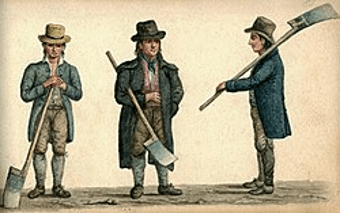
3 Labourers with "fracks" (spades) at Irish Hiring Fair (Credit: Wikipedia)
According to the census records for Ollery Hall Farm, there were five Irishmen who lived and worked alongside the the tenant farmers: the Howards, John Dickinson and the Cunningtons. Of course, there could have been more than this in the years between the 10-yearly census reports. These are just snapshots for 1891, 1901, 1911 etc.
During the Victorian era, farm labourers, including the Irish workers, often changed masters on a regular basis. G. E. Mingay details the hiring of servants and workers in ‘Rural Life in Victorian England’:
‘On some fixed date, usually Michaelmas, Martinmas or May-day, masters and men resorted to the hiring fairs, where the men seeking new masters stood in the market place with some symbol of their trade to indicate the employment required.’
The novelist and poet, Thomas Hardy (1840-1928) in his well-known novel, Far from the Madding Crowd, wrote
‘carters and waggoners were distinguished by having a piece of whipcord twisted round their hats; thatchers wore a fragment of woven straw; shepherds held their sheep-crooks in their hand; and thus the situation required was known to the farmers at a glance.’
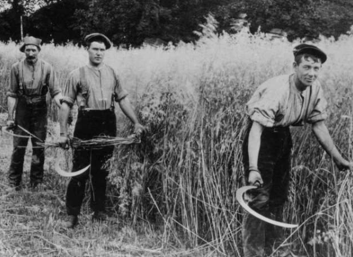
By the late 19th Century, emigration was highest from the far southern and western counties of Ireland; almost half of the emigrants hailed from Limerick, Tipperary, Sligo, Mayo, Kerry, Cork or Galway. Some of the emigration was on a temporary basis such as agricultural workers seeking work in summer and autumn – prime harvest time; they would then return home for winter and spring. This seems to be the case for many of the Irishmen that came to Halsall, although there were definitely some who stayed – not necessarily in Halsall, but in Lancashire or further afield. See our article on the Geraghty Brothers – who regularly visited Halsall to work as agricultural labourers.
Tracing these men is not the easiest of tasks! Missing details, duplicate names and restricted access to Irish records are just some of the reasons that prove this type of research is difficult. However, we can piece together certain strands of information and attempt to create a picture of the individuals who worked at Ollery Hall Farm in years gone by…
Martin Lyons
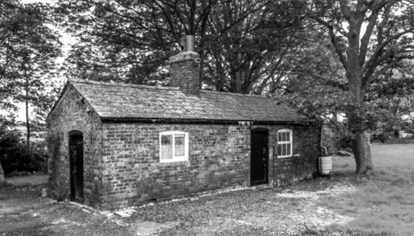
Martin Lyons 🌳 was born in County Mayo, Ireland c. 1841. When he was living and working at Ollery Hall Farm in 1891, he was aged 50 years and single. His occupation was agricultural labourer. Chances are that he lived in the ‘shant’ next to the farmhouse with his fellow workers, Edward Kirk, a 17 year old farm servant and Herbert Daft, a young farm student aged 24.
The 'Shant' at Ollery Hall Farm (Credit: Colin Jones)
Mary Howard, farmer, was the head of the household at that time and 3 of her adult children, Thomas, Edward and Jane were still at home. Also in residence were her grandchildren Charles and Hannah Howard.
Only having such sparse information about Martin Lyons means that it is not possible to be certain of his whereabouts before or after the 1891 census. We do not know who his parents were, when he left Ireland or if he returned to Ireland for example. One thing is certain, he was not the only Martin Lyons born c. 1841 in County Mayo!
Thomas Guilfoyle
Thomas Guilfoyle 🌳 was born c. 1866 also in County Mayo, Ireland. He first appears in the census records for England in 1901 where he is recorded as living on Barton Lane, Downholland with the Rimmer family. He had gained employment as a carter for Thomas Rimmer, a farmer.
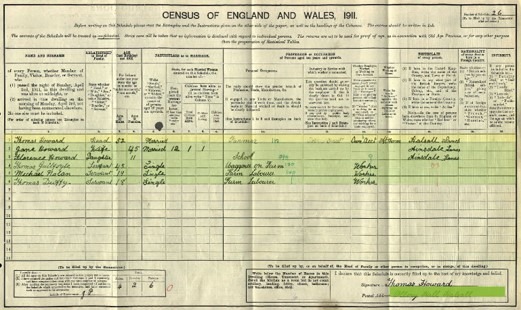
By 1911 he had moved to Halsall and was working for Thomas Howard at Ollery Hall Farm. He was 45 years old and employed as a waggoner which, unsurprisingly, was a person who drove a wagon, typically a horse drawn vehicle used for transporting goods. Unfortunately, by the time the 1921 census was taken, Thomas was an inmate of the Poor Law Institution in Ormskirk. His age was given as 54 years and 6 months and his occupation was that of farm labourer, although no previous place of work was recorded. This is the last we see of Thomas Guilfoyle – research continues to find his date of death.
Michael Nolan
Michael Nolan 🌳 was another Irish worker from County Mayo. In 1911 he was a 19 year old lad living at Ollery Hall Farm and working as a labourer for Thomas Howard, the last of the Howard family to farm there. He would have worked with Thomas Guilfoyle, above and another labourer Thomas Duffy.
Sadly, Thomas Howard’s wife, Jane, had died in 1919 and then only two years later, Thomas ‘sold up’ the farm – Michael would have witnessed both of these personal events that his employer had to endure as he was also listed as living at the farm in 1921. Unfortunately, it isn’t clear what became of Michael after this date; the census records from 1931 no longer exist and he wasn’t listed in Halsall in 1939. We can surmise that Michael was born c. 1892, however, we cannot distinguish which Michael Nolan from County Mayo we have as, again, details are sparse – we do not have an exact date of birth for example which would have helped enormously.
Thomas Duffy
Ollery Hall Farm in Halsall 1911 Census
Thomas Duffy 🌳 was presumably another young Irish labourer; his details in the census records are incomplete, as no place of birth is provided.He was 18 years old in 1911 when he was working at Ollery Hall, making his date of birth c. 1893, although without an exact place of birth it is impossible to trace him through the records.
John Fitzmaurice
(Credit: Irish Family History Centre)
John Fitzmaurice 🌳 was born on 29th April 1914. According to the Register for England and Wales 1939, he was living and working at Ollery Hall Farm as a farm worker for John Dickinson and his stepsons, the Cunningtons. This is all the information we can glean from this register sadly, as places of birth were not recorded on the 1939 Register. Was he an Irish worker or from somewhere else entirely?